easy to know
The Differences Between Flat-Knit Socks and Terry-Knit Socks
Flat-knit socks and terry-knit socks are two distinct types of socks with significant differences in structure and function. Their primary distinctions lie in knitting techniques, material properties, and intended applications.
Content Quick View
Flat-knit socks
1. What are flat-knit socks?
- Flat-knit socks are produced using a plain weave technique, resulting in a smooth, flat surface without noticeable loops or raised areas. During knitting, yarns interlace in a flat plane, commonly as single-sided stockinette stitch (e.g., standard ankle socks) or double-sided stockinette stitch (e.g., some compression socks). Certain styles may incorporate ribbing techniques to enhance elasticity (e.g., at the cuff or arch). This construction yields lightweight socks that conform to the foot’s contours, pairing seamlessly with various footwear without bulkiness.
2. Main Features:
- Breathable and moisture-wicking: The open weave structure facilitates air circulation, while summer lightweight styles quickly wick away moisture from the feet.
- Abrasion-resistant and wrinkle-resistant: After combing out short fibers, the yarn becomes smoother, resulting in 2-3 times higher abrasion resistance compared to ordinary cotton socks.
- Elastic Support: Spandex content provides moderate elasticity to the sock body. Some athletic flat-toe socks feature Y-shaped 3D knitting to enhance arch support.
3.Subcategories and Applicable Scenarios
- Everyday Commuter Style: Thin flat socks are ideal for pairing with dress shoes or casual sneakers, preventing friction against the skin.
- Performance Style: Featuring a honeycomb structure to distribute pressure, these athletic flat-toe socks are ideal for moderate-intensity activities like running and cycling while keeping feet dry.
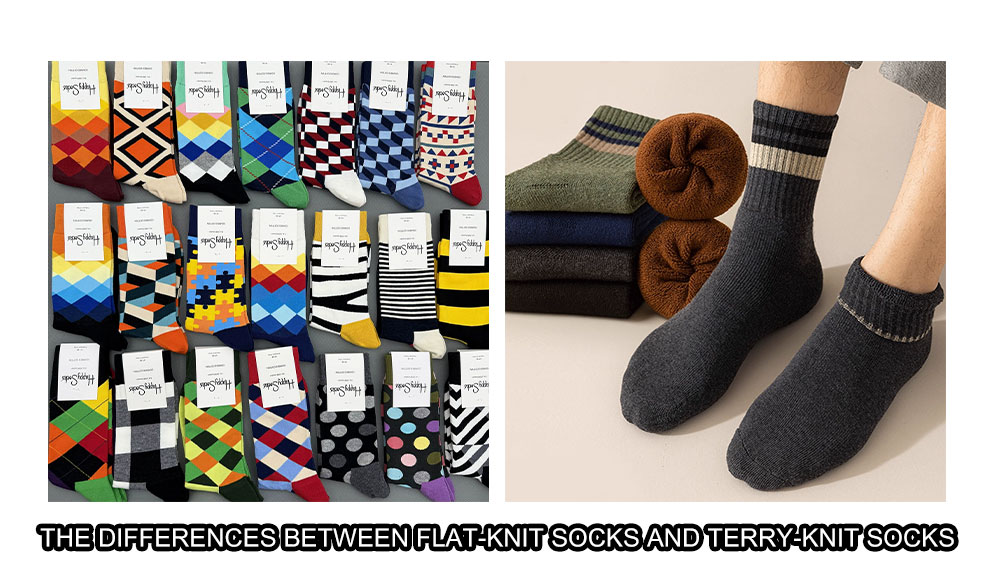
- Trendy Styles: Featuring personalized looks through jacquard weaving and color-blocking designs, such as happy socks’s flat socks.
terry-knit socks
1.What are terry-knit socks?
- terry-knit socks utilize double-sided knitting technology, featuring a smooth flat surface on one side and a dense looped surface (similar to a towel’s texture) on the other. The loops are formed by stretching yarn loops, creating multiple air pockets inside that significantly enhance warmth and cushioning.
- Based on the distribution of loops, they can be classified as:
- Full-terry Socks: The entire inner surface of the sock is lined with fleece, providing optimal warmth and making them ideal for extremely cold environments.
- Half-terry Socks: Only the sole and heel areas prone to friction feature looped fabric, balancing breathability and slip resistance. Ideal for summer or athletic wear.
2.Main Features:
- Thermal Lock: The air layer within the terry loops reduces heat loss by over 30%, maintaining stable foot warmth even in -10°C environments.
- Moisture-wicking and shock-absorbing: The terry loop structure absorbs moisture 40% faster than pure cotton. The athletic version features a dual-density terry loop design that reduces impact force upon landing by 23%.
- Anti-slip and wear-resistant: The sock sole features a looped fabric design reinforced with elastic bands, achieving a friction coefficient of up to 0.85μ. This effectively prevents foot displacement during physical activity.
3.Subcategories and Applicable Scenarios
- Thermal Style: Fully terry-loop construction with fleece lining, ideal for winter outdoor activities or daily wear for seniors, such as children’s cartoon-print terry socks.
- Sporty Style: Dense terry loops at the arch + reinforced elastic cuff, ideal for high-intensity activities like running and hiking.
- Comfort Style: Upper made of flat fabric, lower with terry cloth lining on the sole. Absorbs sweat while preventing heat buildup on the top of the foot, ideal for those who stand for extended periods or have sweaty feet.
- Special Needs Type: Such as specialized terry socks for amputees, featuring soft materials and elastic designs that conform to prosthetics, providing comfortable support.
Summary and Comparison
| Feature | Flat Knit Socks | Terry Loop Socks |
|---|---|---|
| Knit Structure | Flat knitting, smooth surface | Looped terry inside, nubby surface |
| Thickness/Texture | Thin, smooth, (Thickness:1-2mm) | Thick, soft, elastic(Thickness:2-5mm) |
| Primary Function | Breathable, invisible, stylish pairing | Sweat-absorbing, shock-absorbing, cushioning, warm |
| Breathability | Excellent | Good (achieved through moisture absorption) |
| Applicable Scenarios | Formal wear, business, summer daily wear, pairing with dress shoes | Sports, winter, casual, pairing with athletic shoes/boots |
| Intuitive Feel | Feels like the shoe fits perfectly; the sock is almost unnoticeable | Feels like the foot is softly wrapped with a cushioning sensation |
Purchasing Recommendations
Flat-knit socks: Opt for blended fabrics containing 5%-10% spandex. Avoid prolonged high-temperature drying to preserve elasticity. For athletic styles, prioritize seamless construction to minimize friction.
Terry-knit socks: The higher the Xinjiang long-staple cotton content, the better the warmth and durability. For dark-colored styles, add salt during the first wash to set the color and prevent pilling.