
easy to know
What features should good Pilates socks have?
Good Pilates socks need to balance functionality, comfort, and safety to meet the demands of Pilates exercises in terms of body control, balance, and precise muscle activation.
Content Quick View
1. Strong anti-slip properties (core function)
Pilates is mostly performed on a mat, involving a lot of tiptoeing, heel tapping, and shifting of center of gravity, so slip resistance is a top priority.
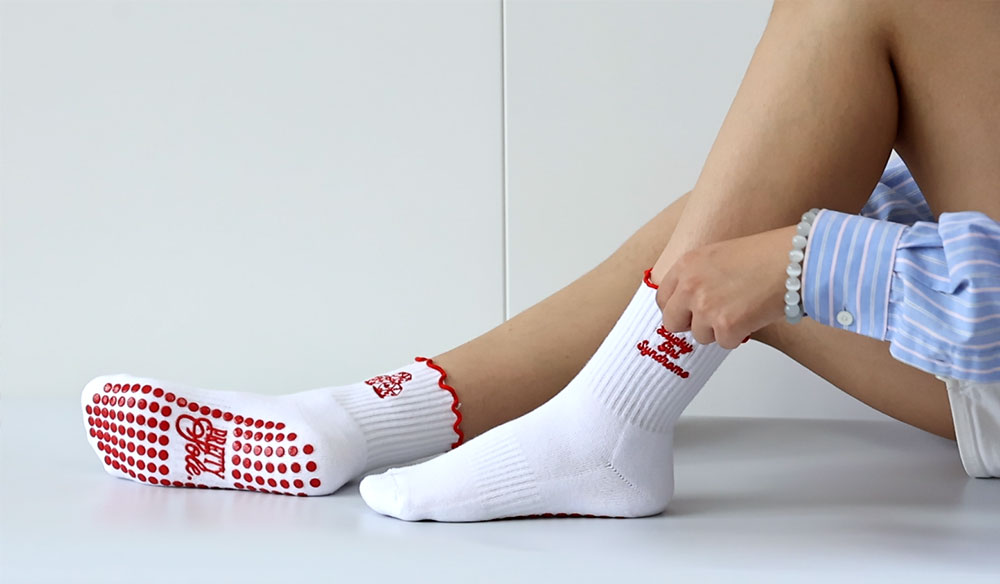
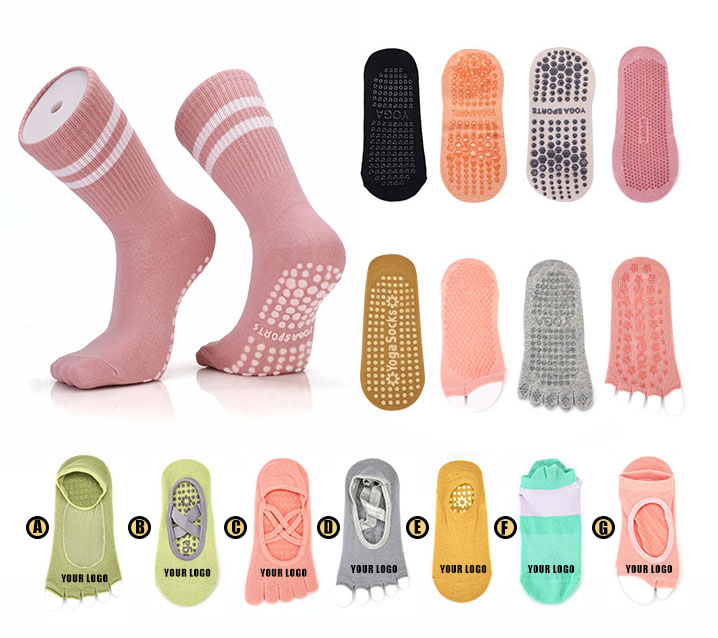
- Anti-slip design: The bottom must have dense and evenly distributed anti-slip particles (mostly made of silicone or PVC). The particles should be round, diamond-shaped, or grid-shaped so that they can evenly adhere to the ground and enhance friction.
- Anti-slip coverage: At least covers the forefoot, heel, and other main pressure points. Some high-quality models extend to the arch area to ensure that the entire foot does not slip when exerting force.
DIY SOCK offers comprehensive customization services, from materials to manufacturing processes, from design to overall coordination. We have professionals who can provide you with solutions. We support orders starting from a pair of samples. If you need a pair of personalized custom Pilates socks, please contact us for a quote and free design.

2. Breathable and sweat-absorbent, skin-friendly material
Feet tend to sweat during Pilates exercises, so the material needs to be both moisture-wicking and comfortable.
- Preferred materials: Mainly natural fibers such as cotton, bamboo fiber, and modal (moisture-wicking and breathable), combined with a small amount of spandex (for added elasticity), avoiding pure synthetic fibers (which can cause sweating and unpleasant odors).
- Weaving technique: The instep uses a mesh weave or breathable hole design to accelerate air circulation and reduce stuffiness in the feet. The sole is reinforced with a thick layer of terry cloth to increase cushioning and wick away moisture.
3. Fits the shape of the foot, with moderate elasticity
Palites Socks should fit snugly but not tightly, to prevent shifting during exercise or restricting blood circulation.
- Elastic design: The sock cuff and arch area should have moderate elasticity (containing spandex) to stretch with the shape of the foot, fit different foot sizes, and prevent slippage.
- Cutting: Cut according to the curvature of the foot, leaving enough space at the forefoot and heel to avoid squeezing the toes or pinching the ankles.
4.Toe exposure/separated toe design (optional but recommended)
Pilates emphasizes “toeing the ground” to stabilize the center of gravity and activate the leg muscles. Toe-exposed or split-toe designs are more suitable for exercise needs.
- Toe-exposed design: Allows the toes to extend naturally, facilitating ground perception and precise force application, particularly suitable for movements that require toe assistance for balance (such as “100 strikes” and “single-leg extension”).
- Split-toe design: Reduces pressure between the toes and improves flexibility, suitable for advanced movements that require high precision.
5.Reinforced heel, wear-resistant and durable
The heel is a part of the body that is frequently subjected to stress in Pilates (e.g., “cat pose” and “bridge pose”), so it needs to be made more durable.
- Thickened loop or double-layer weaving is used at the heel to extend the service life and enhance the cushioning sensation when the heel lands.
6.Seamless, reducing friction
The skin on the feet is relatively sensitive. If the seams of socks are rough or raised, they can rub against the toes and ankles during exercise, causing discomfort or even blisters.
- Preferably use a “bone-free suture” technique, which results in smooth and delicate seams that fit snugly against the skin without causing any foreign body sensation.
7.Moderate thickness, balancing tactile feel and protection
If they are too thick, they will affect the feet’s perception of the ground (reducing movement precision); if they are too thin, they lack basic protection (especially on hard surfaces)
- Focusing on “lightweight, breathable + basic support,” with a thickness of approximately 0.5-1mm, it allows the foot to clearly sense the point of force while also preventing direct friction with the pad surface.
Summary
In summary, good Pilates socks prioritize functionality over aesthetics, with a focus on slip resistance, breathability, fit, and comfort, helping practitioners perform movements more stably and safely.