easy to know
What Features Should a Good Wool Socks Have?
A pair of high-quality wool socks needs to strike a balance between warmth, comfort, durability and functionality. The proportion of wool content will also vary depending on the usage scenario (such as daily warmth, outdoor hiking, business light wear, etc.)
Content Quick View
1. The core features of good wool socks
1. High-quality wool raw materials (core foundation)
The “type” of wool directly determines the upper limit of the quality of socks, rather than simply looking at the “content”
- Merino wool is the preferred choice: recognized as the finest wool, it’s only 11-24 microns in diameter (over 50% finer than regular wool). It’s smooth and non-itchy, and its moisture absorption, warmth retention, and breathability far surpass those of regular wool (such as sheep and goat wool).
- Avoid low-quality wool: If the sock label simply says “wool” without specifying the type, it’s likely coarse wool, which can cause itching and severe pilling.
- Certification marks are a plus: Marks like “ZQ Merino” (New Zealand Premium Merino) and “RWS” (Responsible Wool Standard) indicate the wool is sourced and processed with high standards.
2.Scientific weaving technology (determines durability and fit)
Craftsmanship details directly affect the wearing experience and lifespan
- High knit density: Measured in “needles per inch” (e.g., 144, 168). The higher the needle count, the finer and smoother the fabric, resisting deformation and providing more uniform warmth (low-needle count socks are prone to air leakage and pilling).
- Sock cuff design: Highly stretchy, non-binding, and durable – high-quality socks will have a spandex blend cuff (3-5cm wide) with a ribbed weave that fits snugly around the ankle to prevent slippage without restricting circulation (low-quality cuffs can become loose or overly tight, leading to marks).
- Reinforced key areas: The heel, toes, and sole are prone to wear and tear. High-quality wool socks will feature a double weave or a blend of wear-resistant materials (such as nylon) to enhance durability. (You can observe whether the sole of the sock is noticeably thicker or has a different texture).
- Seamless seams: The suture line of the sock toe needs to be smooth (“boneless suture” process) to avoid rubbing the feet and toes (low-quality socks often have rough and hard wired sutures here, which can easily wear out the skin after long-term wear).
3.Balanced warmth and moisture wicking (wool’s core strength)
The natural property of wool is to keep your feet warm without feeling stuffy. High-quality wool socks should give full play to this advantage.
- Warmth: Wool fibers contain numerous curled “air pockets” that trap body heat and retain over 70% of their warmth even when wet (far exceeding cotton socks, which offer virtually no warmth when wet).
- Moisture-wicking: Wool can absorb up to 30% of its weight in water without feeling damp, and it quickly conducts sweat to the sock’s surface for evaporation (a “wicking effect”), preventing the accumulation of sweat and odor that can build up on the feet. (Low-quality wool socks, due to improper blending, can easily become stuffy and sticky.)
4.Good elasticity and fit (no slipping or bulkiness)
High-quality wool socks should be “fitting but not tight” to suit different foot shapes
- Elasticity comes from the appropriate addition of spandex (usually 3%-5%), which allows the socks to conform to the foot and prevent wrinkles without restricting movement (for example, preventing socks from sliding and rubbing when hiking).
- Avoid excessive elasticity: Too much spandex (>5%) can cause the socks to be too tight and compress the foot; too little can lead to looseness and deformation.
5.Low pilling, easy to care for
Although wool socks are bound to pill, high-quality products can reduce pilling through process control.
- Pilling: High-quality wool (such as Merino) has fine, uniform fibers, resulting in fewer “pills” that are difficult to remove. If socks develop dense pilling after just a few wears, the wool may be of poor quality or have a loose weave.
- Easy Care: Most high-quality wool socks are suitable for “gentle machine wash” (check the label, generally use water temperatures ≤ 30°C, use a neutral detergent, and avoid bleaching or tumble drying—high temperatures can cause wool to shrink). Some are shrink-resistant (such as chlorination) to reduce the risk of shrinkage.
6.Comfortable and non-irritating
- The scratchy feel of wool comes from its coarse, hard fibers. Merino wool, with its fine diameter (<25 microns), is less irritating to the skin and suitable for sensitive skin. Socks labeled “Extra Fine Merino” (diameter <18 microns) feel closer to cotton.
- Avoid chemical residues: High-quality socks are dyed using legal procedures, have no pungent odors, and retain their color after washing. (Lower-quality socks may contain formaldehyde residue, which can cause skin allergies.)
2.Common ingredient ratios of wool socks
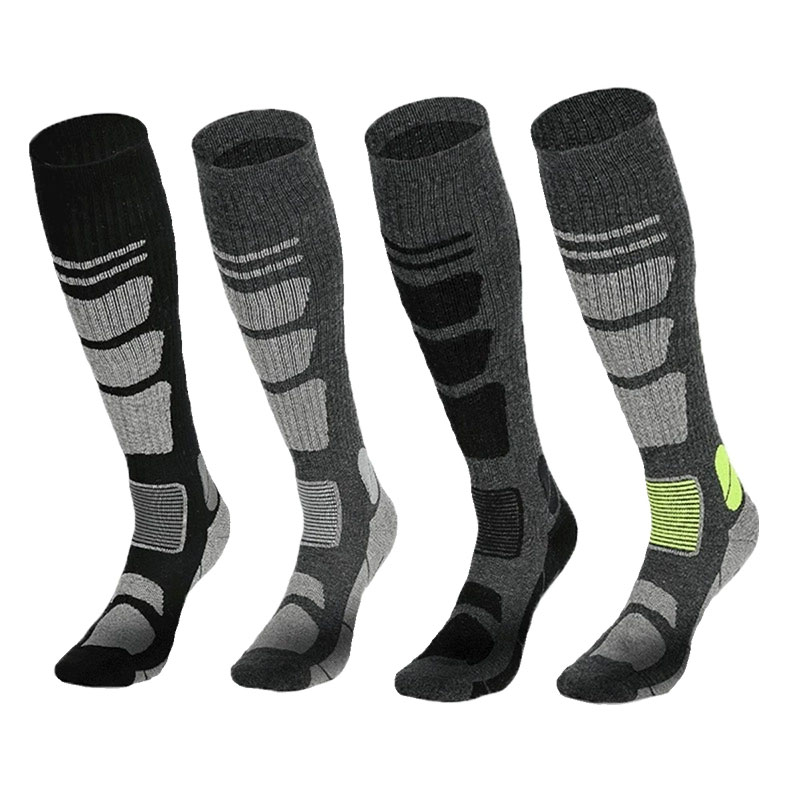
Wool socks are rarely “100% pure wool” (pure wool is prone to shrinkage, deformation, and poor wear resistance). They are usually blended with nylon (nylon/polyamide, which enhances wear resistance) and spandex (which enhances elasticity). The proportions vary significantly in different scenarios.
| Application Scenario | Wool Content Percentage | Blended Components (Main) | Key Features | Examples |
|---|---|---|---|---|
| Everyday Warmth | 50%-80% | Nylon 15%-30%, Spandex 3%-5% | Balances warmth, comfort, and durability; high cost-performance | Winter commute socks, home socks |
| Outdoor Performance | 60%-90% | Nylon 10%-25%, Spandex 3%-5% | High wool content ensures warmth/moisture-wicking; nylon enhances durability | Hiking socks, ski socks (mountaineering socks) |
| Lightweight & Breathable | 30%-50% | Nylon 40%-60%, Spandex 3%-5% | Thin and non-bulky, suitable for spring/autumn or dress shoes | Wool dress socks for leather shoes |
| Premium Softness | 80%-95% | Spandex 3%-5%, small amount of Nylon | Primarily Merino wool, offering supreme softness and warmth | Infant wool socks, sleep socks |
Key Notes:
- Why not choose 100% wool?
- Pure wool fibers lack elasticity and tend to shrink and lose their shape after washing. They also wear easily around the heels and toes, potentially causing holes after just a few wears. This makes them far less practical than blended options.
- A higher ratio isn’t necessarily better
- For durability (like hiking), a ratio of around 70% wool and 25% nylon is ideal. For extreme warmth (like sub-zero temperatures), opt for a style with over 90% merino wool and a small amount of spandex.
3.Practical tips for choosing wool socks
- Check the label: Choose “Merino wool” with specific content information (e.g., “70% Merino Wool + 25% Nylon + 5% Spandex”). Avoid vague labels that simply say “wool.”
- Touch the texture: Rub the sock surface with your hands. High-quality wool socks have a smooth, resilient feel, and no noticeable stiffness. If they feel rough or prickly, they may be low-quality wool.
- Try on (offline): Focus on whether the sock cuffs are tight, whether the toe box is uncomfortable, and whether the sock fits snugly (avoiding overly loose or tight).
- Check the price: High-quality Merino wool socks typically cost between $10 and $30 (outdoor styles may cost more). Low-priced “wool socks” often have a low wool content or are of lower quality, so be cautious.
DIY SOCK offers comprehensive customization services, covering material selection, production processes, design solutions, and overall coordination. We have a professional team that can provide you with customized solutions. We support orders starting from one pair of samples. If you need custom wool socks, please contact us for a quote and free design services.
Summary
By combining the above characteristics with the proportion of ingredients, you can better choose wool socks that suit your needs.